Football For Social Change And Evidence-Based Advocacy
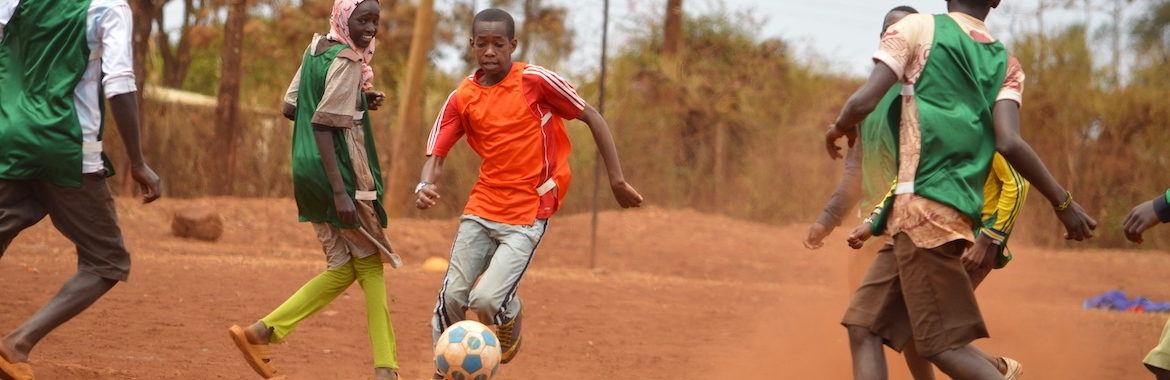
School children and young people play football every week. We use that influence on the social fabric to reach a wider population, and to shift how young people and their communities think.
Football is how we reach children who would not come to a meeting. It is also how conversations start that are otherwise closed: on female genital mutilation, menstrual health, gender-based violence and conflict. Participants come for the match and stay for the session.
HODI has run this work since 2007 as Shoot To Score.
What We Are Trying To Change
Our objective
to develop and strengthen football programs and infrastructure as a vehicle to advocate for peace, child rights and social change in the Horn of Africa.
We pursue this in four ways: football for peace; engaging communities in football as a tool for social change; developing football talent; and mobilising the equipment and infrastructure that makes play possible.
What We have Accomplished
Across 2024 and 2025:
- 1,026 young people took part, 318 of them girls
- 40 coaches trained, 21 of them women
- 64 teams registered across two league seasons, run with the Football Kenya Federation
- Agreement with gender equality principles among players and coaches rose from 10 per cent at baseline to 50 per cent at endline
- Evaluation recorded a 90 per cent improvement in positive interaction between young people from different ethnic and social backgrounds 80 per cent of trained coaches were present at football hour and league matches
- The Hulahula pitch repaired and 50 footballs distributed
Building the space to play
Children cannot play without somewhere safe to play. In Marsabit many schools have no playing surface at all, only uncleared ground where bush and shrubs have caused snake bite incidents. A needs assessment identified the schools where the absence of safe space, rather than distance or interest, was the barrier to participation. That became our selection criterion.
We use football sessions to provide girls and boys with equal opportunities to play football on safe spaces, fostering peace through weekly football sessions while showcasing the power of football to bridge ethnic divides. The project also educates participants on gender equality topics. A number of approaches are used in this project:
- Weekly football sessions for girls and boys, delivered by trained coaches and peer educators
- Football leagues and annual football tournaments for young girls and boys
- Provision of balls and other football equipment to participants and the repair of some of the football pitches used in the project
Funded by the FIFA Foundation and GlobalGiving. Running since 2007.
Shoot to Score, Not to Kill uses football to reach children with life skills and to open conversations that are otherwise closed.
How it works
The programme runs nineteen weeks, two hours a session. The first hour is a life skills module, the second hour is a league match. The five modules are communication skills, health and hygiene, conflict resolution, children’s rights and gender equality, and financial literacy. Individual sessions cover menstruation, hygiene, bodies, emotions and sexuality, peer pressure and living with HIV. A baseline survey sits in week one and an endline survey in week seventeen, inside the same session structure as the football, so measurement is designed in rather than added afterwards. We use the football3 methodology.
Safe spaces
Life skills sessions are delivered in designated safe spaces where female genital mutilation, menstrual health, gender-based violence and conflict can be discussed without an audience.
Who delivers it
Coaches are young people from the same communities as the players, not visiting staff. They are trained in first aid, life skills delivery, safeguarding, and hygiene and menstruation. Most stay on as volunteers after the season ends. Leagues and annual tournaments are run with the Football Kenya Federation.
Results across 2024 and 2025
1,026 young people, 318 of them girls, 40 coaches trained, 64 teams, and a 90 per cent improvement in positive interaction across ethnic and social lines.
Our Sport on the Cutting Edge project aimed to end female genital mutilation in Marsabit. FGM is highly prevalent in northern Kenya, with UNICEF putting the prevalence rate at 98% in some areas.
FGM is responsible for many harmful effects, including infections, painful urination and menstruation, keloids, sexual health problems, childbirth complications, fistula, perinatal risks and mental health problems.
To progress towards the end of FGM in Marsabit, we use the following approaches:
- Weekly football and life skills sessions to adolescent girls, delivered by trained coaches
- Training of traditional circumcisers on the dangers of FGM and providing them with financial literacy courses and support to earn alternative income
- Workshops and provision of information materials on the dangers of FGM for community leaders such as religious leaders and chiefs
Supported by Comic Relief. Anti-FGM work in Marsabit.
Sport on the Cutting Edge works to end female genital mutilation in Marsabit. Prevalence in Marsabit County is 83 per cent (Kenya Demographic and Health Survey 2022), against a national average of 15 per cent.
FGM causes lasting harm: infection, painful urination and menstruation, keloids, sexual health problems, childbirth complications, fistula, perinatal risk and mental health problems.
How we work on it
- Weekly football and life skills sessions for adolescent girls, delivered by trained coaches
- Training traditional circumcisers on the dangers of FGM, with financial literacy and support to earn an alternative income
- Workshops and information materials for community leaders, including religious leaders and chiefs
The approach rests on a simple point. A girl will not raise this in a classroom. She will raise it with a coach of nineteen who plays alongside her every week.
Support for Our Breaking the Silence Program
HODI is grateful to the FIFA Foundation, GlobalGiving, iShowSpeed Foundation and Comic Relief for their support of this work.


Our Awards